
“His words were a hammer to the team’s morale.”
A strong metaphor can change how someone sees a situation, bringing a new perspective, focus, and depth of understanding—assuming everyone involved interprets the metaphor the same way.
What does this have to do with leadership?
As a leader, you will often have to convey many complex ideas and emotions quickly and consistently. A strong metaphor can deliver all that and more in just a few memorable words, making it easier for the team to grasp and remember the message. For example, if we talk about the company strategy and say we are “climbing the ladder to success,” it brings an image of a step-by-step process toward a goal. You can also use a metaphor to help encourage a particular way of thinking or looking at a situation. Do you want the team to “weather the storm” or “navigate the storm?” One is passive and defensive, while the other is active and forward-moving. Finally, you can use a metaphor to help build shared understanding and team culture. If you say the team is “an orchestra of professional players,” you are creating the sense that everyone is an expert, yet they also need each other to truly perform. Using metaphors, you can inspire, clarify, and unite your teams in ways that transcend traditional communication.
As a leader, you should always be exploring and learning. I wanted to ground you in the power and importance of a good metaphor so I could introduce you to a new one that resonated with me instantly.
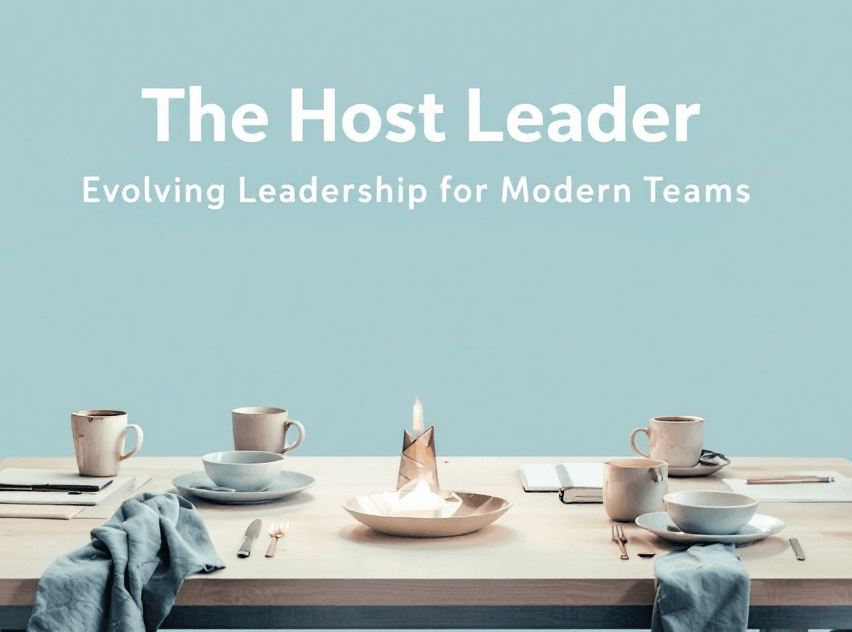
Host Leader: A new leadership Metaphore
There have been several metaphors for leaders, the current most common being the “servant leader,” popularized by Robert Greenleaf. This metaphor is meant to conjure images of a leader who puts the needs of their team ahead of their own. The servant leader serves others to unlock their potential and achieve collective goals. It’s a powerful metaphor that has guided leaders to adopt humility, empathy, and a service-oriented mindset. It is certainly not bad or wrong. But, like everything around us, leadership evolves, and so the metaphors we use have to grow with it.
I was first introduced to an even more powerful and more holistic leadership metaphor in March of 2021 when author Mark McKergow did a workshop at Siemens sharing lessons from his new book “Host – Six New Roles of Engagement.” Mark walked us through his new metaphor – the Host Leader. It resonated with everyone instantly! You see, while we all liked the metaphor of the servant leader, none of us had been or had servants. But, we had all hosted and attended various gatherings and could fully relate to both the host and the guest roles.

I love hosting. Actually, as I write this, it is Easter Sunday morning, and 2 of my four kids will be here for brunch this afternoon. I will do my best to do justice to Mark’s great work by comparing my brunch preparations to leadership through the lens of his Host Leader metaphor. I will focus on the six roles outlined in the book. The metaphor is so rich and complex that there is much more to it than I will touch on here. If this resonates with you as it did with me, I encourage you to check out Mark’s book: https://amzn.to/42jqTW6
As you read through these, keep in mind that this is not a process flow. You move between these roles depending on the situation at hand.
1. Initiator
Someone has to have the idea to do something and then start to do it. Ok, in my Easter example, that is really my wife more than me, but I will take credit anyway 😊. We knew we wanted to have the kids over for Easter, so we started looking at food options and making a plan.
The initiator role has the spark to get something going. As a leader, this will most often need to be you. You may get inspiration from a team member, a leader above you, or a brilliantly written blog post. But inspiration without perspiration is just a dream. In the initiator role, you have to notice a need and take some small action to get the momentum started. This initial small action is enough to break the barrier of inaction.
2. Inviter
This sounds natural for an Easter brunch. We invited our kids to come over. Easy enough, right? But only 2 accepted due to schedules and other logistics. Think about that – inviting has some interesting characteristics. It is worded to encourage them to want to come. It lets them know we honestly want them in our home, yet they have a choice.
As a leader, this feels harder. If you think invitationally, you are inviting your team to participate, not ordering them, and they have the option to say no. Your job as a leader is to make sure you are conveying why you want them to participate, what value they bring, what value and purpose the project serves, and to build their desire to participate. By empowering the team this way, you will have much stronger buy-in and commitment than if you order them. If they say no, you need to have a critical look at your inviting mindset and process.
3. Space Creator
Ug. This one can be a pain at my house. It often involves a whirlwind of cleaning up weeks or months of things we meant to get to but just didn’t. We clean, organize, and make ready the space for our guests to come. We need the space to be fit for purpose – in our case making and eating brunch. This role also means keeping the space during the event – so cleaning up a spill, refreshing drinks, and the like.
I challenge you to think about two kinds of space you need to create and maintain as a leader. The first is the physical or virtual space. There may be a meeting room, a team area, an online meeting, a message board, or even a file repository. Based on the goal of your ‘event,’ how can that space be best organized, presented, and shared? What might distract the team or detract from their work? The second space that we often overlook is the mental and emotional space. You are setting the tone for the mental and emotional space. The question is, are you doing it with intention, or is it just happening? You need to be intentional about the mental and emotional space you create. Are you asking open-ended questions to show curiosity and make space for the team’s input? Are you admitting when you don’t know or need help to create collaboration?
4. Gate Keeper
The intent of the gatekeeper’s role is to set and maintain boundaries in terms of people involved, rules, routines, and processes. At our house, sometimes pets are invited and sometimes not. For this particular Easter brunch, we decided that pets are not invited. Side note: we are a pet-loving family, so when pets are invited, it gets rather …um.. energetic. So, part of our gatekeeping duty is to make sure no pets come. We will be having a buffet-style brunch, so as another part of our gatekeeping, we will be sure to share how we want the buffet to work.
Your gatekeeping role as a leader is to set up, maintain, and adjust the people, rules, routines, and processes surrounding your team or project. Mark refers to this together as maintaining the container in which the team operates. Your mission is to create and dynamically adjust the best environment for your team to deliver results. What routines will you put in place that will empower your team? What rules can you create that protect your team from others? What people should you invite from outside of your team? Are there some you should ban?
5. Connector
Yes, connecting two people who don’t know each other is the surface level of the connector, but really connecting is about giving. You may think that because our Easter brunch is all family, there is no connector role. When I ask my daughter how her job is going, that’s connecting. When I make a piece of woodwork for my granddaughter, that’s connecting. When I give my son some thoughts from my 20+ years of experience, that’s connecting.
As a leader, you need to be a consummate connector. You need to connect people to each other so they can build together. You are also on the lookout for ideas to connect to people or to other ideas. By connecting people and ideas, you will build a network of creativity and innovation around yourself. To build a strong team, you also need to be connecting with them by caring about where they are and where they want to go.
6. Co-Participator
You can bet your bottom dollar that I will be eating the Honey Baked Ham and other goodies we will be serving. But only after everyone else has been served. And only after I have explained what we have and how the buffet will work. And, while I am eating, I will be watching how much food is out and if needed I will get up to replenish supplies. So, while I am indeed a co-participator, I am still the host. It’s a balance.
You will need to keep this balance as well. You need to serve your team first, but then you should join them and eat the same food they eat. And while you may be participating with them, you have to keep an eye on the overall flow and the container (back to the gatekeeper). You may see something that is slowing or blocking the team and need to take care of that.
Just the beginning
This is a very short overview of the rich framework laid out in the metaphor of the Host Leader. In addition to the 6 roles, there are also 4 positions and the idea of stepping forward and stepping back. There is so much more to explore here! Check out Mark’s book or his course on Udemy.
I really hope that there was a nugget or two in here that gave you some ideas on how to improve your own leadership.
What steps will you take this week to become more like a host leader?
Unlock Your Leadership Potential! 🎯
Are you ready to elevate your leadership skills and drive meaningful change within your team? Download my Core Leadership Navigator Guide today and discover essential skills that can transform your leadership journey. Whether you’re a seasoned leader or just starting out, this guide offers actionable insights and practical exercises to help you grow and succeed.

If you are ready for a growth partner who will help you set goals, measure progress and maintain accountability, get in touch with me.
💬 Join the conversation!
This article is also available on LinkedIn [link opens in new tab]
Your comments and insights help our entire leadership community grow.